Mice
American WomanMice are a persistent but mostly unseen presence in the farmhouse, where their activity disrupts sleep, damages bedding, and provokes disagreement among its occupants. The response to them moves from frustration and an unsuccessful attempt to kill them toward Jenny and Pauline’s joint use of a humane trap. In that change, the mice become more than a household nuisance: their cautious entry into the trap and collective escape give the two women a small, repeated task organized around care rather than control.
Presence in the Farmhouse
Pauline says that the mice make it impossible for her to sleep, although Jenny replies that she hardly ever sees them. Their absence from view does not mean they are gone: Pauline suggests they have simply become more careful. That difference in perception runs through the episode. The mice are not always visible, but their presence is made concrete by the damage they leave behind and by their sudden movement when Jenny and Pauline enter the kitchen at night.
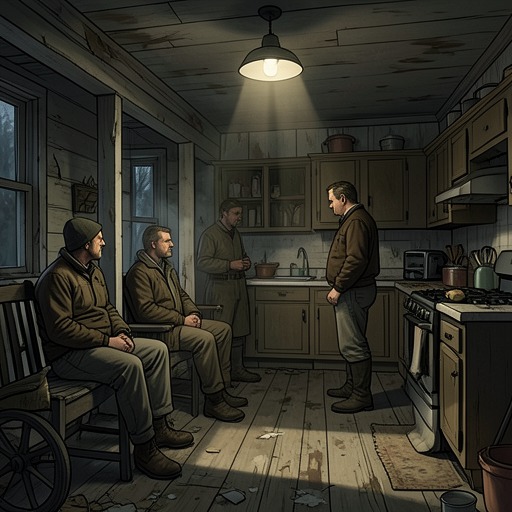
A few days before the night-time encounter, Pauline drags her twin mattress through the bedroom doorway into the front room. She insists that the mice were in her bed and points out a fist-sized hole in the mattress ticking. Juan orders her back to bed, while Yvonne tries to calm her by pointing out that the animals are much smaller than Pauline. The exchange makes the mice a source of friction within the crowded household: Pauline’s alarm is treated as a complaint, and Juan’s response turns the dispute into one about how she treats the others as well as about the animals themselves.
Jenny stuffs the hole with crumpled newspaper, but the repair requires negotiation over which pages can be used. Pauline wants to preserve many of them, including pages she has annotated; Jenny eventually fills the opening and seals it with the cellophane tape she uses for her letters. The damaged mattress thus draws together the mice’s physical intrusion and the household’s improvised routines. The repair depends on salvaged materials and on Pauline’s attention to the marked-up pages, not on a clean separation between domestic life and the fugitives’ other concerns.
From Traps to a Humane Alternative
The next day, Jenny sets wooden mousetraps partly to feel that she is doing something effective. When one catches a mouse, she picks up the trap and throws it into the pond. She worries afterward that the wood might float and prolong the animal’s death, though the injured mouse’s weight carries it under. Yvonne gives Jenny a large mug of wine when she returns. Pauline, wrapped tightly in a sheet on the couch, objects to the way the mouse was killed and says the traps do not solve the problem. Her response makes clear that catching mice is not, for her, the same as dealing with them successfully.
After stargazing with Juan, Jenny drives first to the hardware store in Monticello and then to one in Liberty. She continues along the state road, asking in each town for something that will deal with mice without hurting or killing them. At the fifth store, an owner brings out a metal box with a handle on top and an egg-timer-like dial on its side. He calls it humane but admits he has never sold one before and does not know whether it works. Jenny’s search is practical and specific: she is looking for a way to remove the mice without repeating the outcome of the wooden traps.
The Ticking Box
Jenny later retrieves the metal trap from under her bed to show Pauline. A small inward-opening flap lets mice enter; a larger door can be unlatched from outside to release them. When wound, the dial makes the box tick. Jenny explains the instructions: mice are supposedly curious about unfamiliar sounds, so they may explore the trap and enter it. The directions also suggest that once the first mouse is caught, more may follow. Pauline questions why the animals would go in, keeping the device’s promise uncertain rather than treating it as proven.
That night, with Juan asleep downstairs, Jenny and Pauline enter the kitchen. Jenny lights a candle and fixes it to the lid of a can with wax. Pauline pours wine, and they settle separately on the counter and table while the trap ticks on the floor. They wait without talking. When a mouse approaches, it circles the box, turns away, and eventually goes inside. A second and then a third follow; over the rest of the night, more mice enter until the trap is full. Their movements are described through Jenny and Pauline’s watchfulness, but the animals’ hesitation, entry, and repeated efforts to get out give the scene its own unfolding action.
Release and Recurring Ritual
At dawn, Jenny lifts the trap by its handle. The gathered mice shift inside as they try to escape, and Pauline covers her ears. Still, she gets down from the table and holds the back door open so Jenny can carry the box outside. They cross the wet grass, pass the barn and the small lily pond, and continue over a fence. Pauline at first hesitates because the mice are contained, then picks up the trap and passes it over to Jenny.
Near the woods, Jenny sets the box down and opens its large door. At first nothing happens. She lightly kicks the trap, steps away, and gestures the mice toward the trees. They stream out through the grass. Jenny already understands this first release as something she will do again: the act is the beginning of a new ritual, not a single solution that ends the mice’s presence in the farmhouse. The trap’s design, which makes capture temporary and release possible, gives that repeated task its form.
Narrative Significance
The mice remain animals with behavior that exceeds the household’s plans: they are difficult to see, enter the ticking box on their own, and resist its confinement. Yet the episode is chiefly organized through Jenny and Pauline’s attention to them. Their shared vigil and joint release create a brief cooperation within a household where complaints about the mice have already produced conflict. The change from wooden traps to the metal box does not establish that the problem is permanently solved. Instead, it shows Jenny choosing a different response and imagining its repetition, while Pauline moves from alarm and objection to helping carry the captured mice away.